
Bristol County Court Records After Arrest
After a Bristol County arrest, the first public question is often whether the person is still in custody. That is not the same question as whether a formal case has opened. The Bristol County Sheriff's Office controls jail custody information for the Bristol County House of Correction & Jail, Dartmouth Women's Center, and Ash Street Jail and Regional Lock-Up. The Massachusetts Trial Court controls the case record after charges are filed, and the Bristol County District Attorney's Office prosecutes many criminal charges in the county.
The custody path can start at Ash Street because research identifies Ash Street as a regional intake and initial booking site. From there, a person may be released, moved to Dartmouth, held for arraignment, or kept on a warrant or dangerousness issue. The court path begins when a complaint, indictment, or other charging record reaches the court. For jail custody and mail-routing details, use Bristol County jail inmate records. For booking photo questions, use Bristol County jail mugshots.
Custody vs. court: A jail booking label is not the final court charge. Prosecutors can add, reduce, amend, dismiss, or decline charges after arrest.
Find Bristol Court Records After Arrest
The official statewide starting point is the Massachusetts Trial Court public case system. Mass.gov's court dockets, calendars, and case information page points the public to tools for basic case details and scheduled court dates. Mass.gov states that public searches can show party, event, docket, and disposition information, with document access depending on the court department and case type.
The MassCourts public portal is JavaScript-driven, so not every field was fully captured in the research environment. Official Trial Court sources still confirm enough to build a practical search table. Name searches are available for some case types, docket or case number searches are supported, and case-type or date filters may help when a common name returns too many cases.
| MassCourts Field | Type | Use After Arrest |
|---|---|---|
| CAPTCHA or access gate | Challenge | Required before public search access. |
| Docket or case number | Text | Best when the court or clerk has already provided the number. |
| Name or party search | Text | Useful for a defendant search where name access is available for the case type. |
| Case type | Filter | Helps separate criminal cases from civil or other matters. |
| Date range | Date fields | Useful when the arrest date is known but the docket number is not. |
| Court department or division | Dropdowns | Helps narrow the search to District Court or Superior Court. |
The Mass.gov docket page shows the public route for court calendars and case searches.
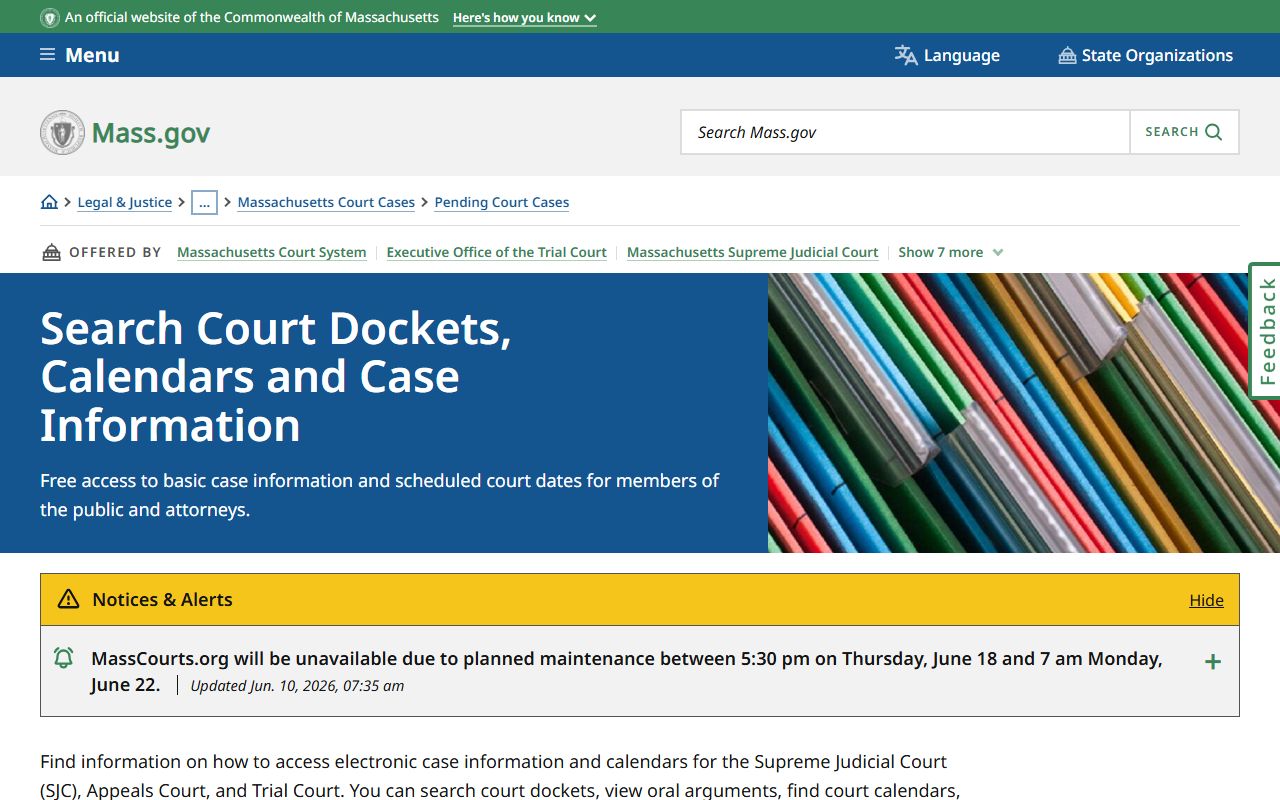
That state page is important because Bristol County court records after arrest are Trial Court records, not a sheriff roster or jail census record.
Bristol Criminal Court Locations
Bristol County has more than one courthouse path. The Bristol County Superior Court in Taunton serves the county. The Bristol County Superior Court in Fall River handles criminal matters and is listed at 186 South Main Street, Fall River, MA 02721. The New Bedford Superior Court location handles civil matters only, so it should not be the first stop for most post-arrest criminal charges unless the question involves a related civil case.
District Court matters can include arraignments and complaint cases after arrest. The Fall River District Court serves Fall River, Freetown, Somerset, Swansea, and Westport. Attleboro District Court is listed in official criminal-process location material at 88 North Main Street, Attleboro, MA 02703. A defendant's arresting city, charging police department, and first appearance often point to the right District Court.
| Court Route | Best Use | Bristol County Note |
|---|---|---|
| District Court | Arraignments, complaints, many misdemeanors and felonies | Often the first court stop after a jail arrest. |
| Superior Court | Serious felony indictments | Fall River Superior Court handles criminal matters. |
| Clerk's office | Official copies and terminal access | Needed when remote access is limited by court rules. |
Bristol Charging Documents After Arrest
Formal court records after a jail arrest usually begin with a charging document. A police booking record may name suspected offenses, but the case record turns on what is filed in court and what the judge or clerk accepts. Massachusetts District Court complaint procedure standards apply after arrest, and serious felony matters can move by grand jury indictment.
| Document | Who Uses It | What It Does |
|---|---|---|
| Complaint | District Court process after police or complainant review | Starts many post-arrest criminal cases and identifies the alleged offense. |
| Information or prosecutor filing | Prosecuting authority where allowed by process | Frames charges the Commonwealth chooses to pursue. |
| Indictment | Grand jury and Superior Court | Moves serious felony charges into Superior Court prosecution. |
Probable-cause review is a separate safeguard. Trial Court Rule XI governs probable-cause determinations for people arrested without a warrant when they remain restrained. That review does not mean a conviction exists. It means the court is checking the legal basis for continued restraint before the case proceeds.
Bristol Charge Status Records
Court records after a jail arrest can change quickly. A count may be pending at arraignment, then amended, reduced, dismissed, continued without a finding, or resolved by plea or trial. That is why the court docket is more reliable than a booking label when the question is the legal status of a charge. The jail may hold a person while the Trial Court owns the docket, calendar, and disposition fields.
| Status | Plain Meaning | Why It Matters |
|---|---|---|
| Pending | The case or count remains open. | Future court dates or motions may still be scheduled. |
| Amended or reduced | The charge changed after filing. | The final charge may differ from the arrest or booking label. |
| Dismissed | The count ended without a conviction on that charge. | Sealing may be available for some non-conviction records. |
| Nolle prosequi | The prosecutor declined to proceed. | The charge is not the same as a guilty finding. |
| Continued without a finding | A Massachusetts disposition that may later dismiss if conditions are met. | It must be read carefully before treating it as a conviction. |
| Disposition | The current or final outcome. | Mass.gov says disposition details may appear in case searches. |
Note: Bristol's Chapter 126 report says sheriffs could not populate case disposition, bail amount, or reason no bail was set because those data originate with the Trial Court.
Bristol Bail and Warrants
Massachusetts bail practice is not built around a commercial bail-bond model. M.G.L. c. 276, Section 58 governs recognizance, unsecured appearance bond, and bail determinations. Section 58A allows the Commonwealth to seek dangerousness detention or strict conditions for listed offenses, and Section 58B covers detention after some release-condition violations.
BCSO's bail notice says bail posting follows designated times and that bail above $5,000 must be posted by bank check payable to the Commonwealth of Massachusetts. It also ties release to the Warrant Management System. M.G.L. c. 276, Section 29 requires a warrant check before release, discharge, or admission to bail in a criminal matter.
| Release Issue | Meaning | Record Route |
|---|---|---|
| Personal recognizance | Release on a promise to appear. | Court docket and bail order. |
| Cash bail | Money set to secure appearance. | Court order, with BCSO posting rules if held. |
| Dangerousness hold | Detention or conditions after hearing. | Court record under Section 58A. |
| Warrant hold | Another warrant blocks release. | Court or law-enforcement warrant system, not a public BCSO roster. |
Bristol Court Access Rules
Remote access is not the same as full courthouse access. Uniform Rule 5 governs remote access to electronic court records. Uniform Rule 2 governs access to records in a courthouse, including electronic public access terminals. When MassCourts does not display a document, the next step is often the clerk, register, or recorder where the case was filed.
The Mass.gov docket search instructions are the better source for court records after arrest than a jail site because the Trial Court, not BCSO, controls docket events and dispositions. BCSO can still be the right agency for custody or census records, especially if the question is whether someone remains in county custody.
The MassCourts entry screen is the state court portal for public case searches.
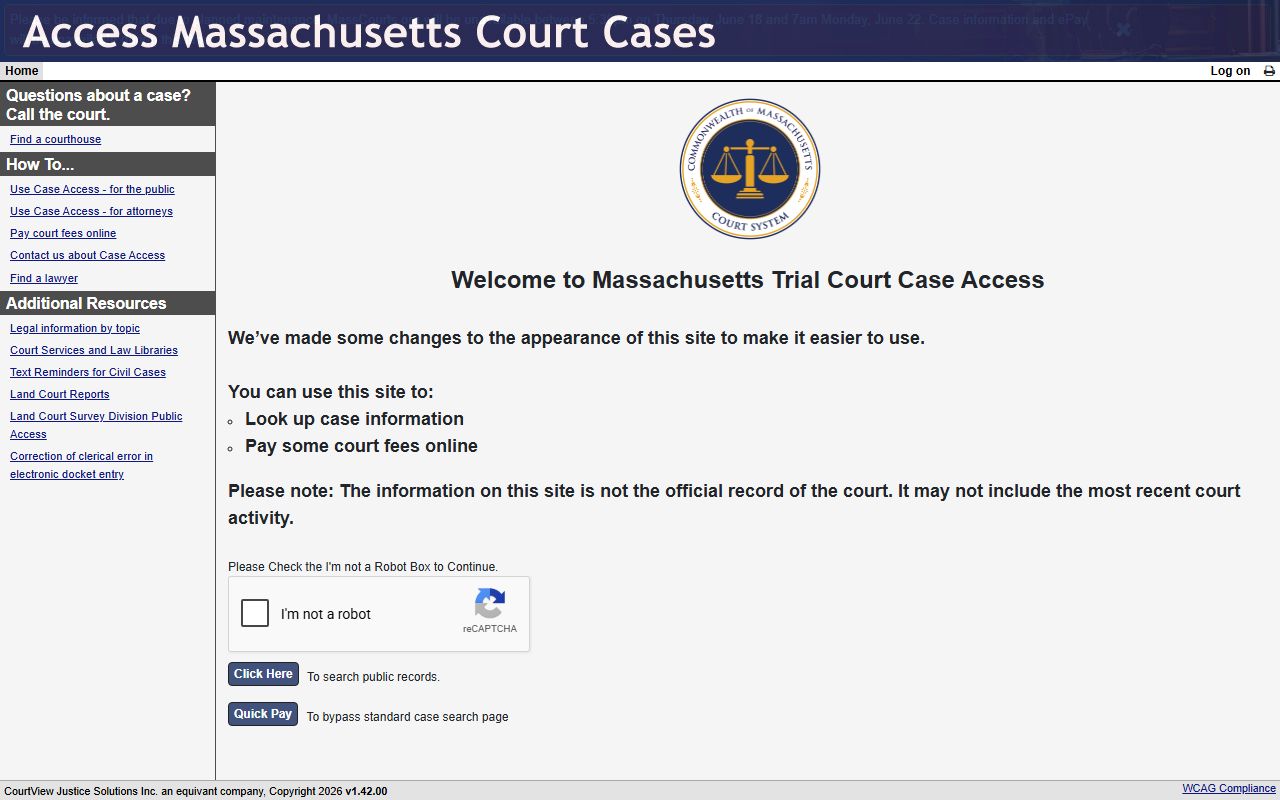
Use the portal for the case search, then use the court clerk when the official record or a hard copy is needed.
Bristol Charges vs Convictions
A charge means the government has accused a person of an offense. A conviction means the case reached a guilty plea, verdict, or other qualifying finding. Public court records after a jail arrest may show both, but a pending charge, dismissed count, or nolle prosequi is not a conviction.
| Record Point | Charge | Conviction |
|---|---|---|
| Stage | Accusation after complaint, indictment, or other filing. | Outcome after plea, trial, or qualifying finding. |
| Proof level | Probable cause or charging standard. | Proof beyond a reasonable doubt or admitted guilt. |
| Effect | May change or end without conviction. | Can affect sentence, custody, CORI, and future case handling. |
Sealed and Expunged Records
Massachusetts has separate routes for sealing and expungement. Sealing usually limits public access to a record, while expungement is defined as erasure or destruction for qualifying records. The main statutes identified in the research are M.G.L. c. 276, Section 100A, Section 100C for non-conviction sealing, Section 100E for the expungement definition, and Section 100K for expungement grounds.
| Record Action | What It Does | Common Bristol Use |
|---|---|---|
| Sealed | Restricts public access while leaving the record in controlled systems. | Eligible convictions or non-conviction outcomes. |
| Expunged | Treats the record as erased or destroyed where the statute applies. | Narrower cases that meet statutory grounds. |
| Not sealed | Public access may remain subject to court rules and CORI law. | Pending and many resolved cases until relief is granted. |
CORI law also matters. M.G.L. c. 6, Section 167 defines Criminal Offender Record Information, and Section 172 governs dissemination rules. That is why casual court lookup, official CORI, and jail records requests can return different levels of detail.
Background Check Limits
MassCourts and courthouse records can help a person understand what happened after a Bristol County arrest, but they are not a substitute for a legally compliant employment, housing, credit, tenant, insurance, or licensing screening process. Official CORI requests follow the Massachusetts CORI route, and consumer reports are governed by separate federal and state rules.
Important: Public lookup information may be incomplete, delayed, restricted, or later changed by the court. Verify case status with the court that holds the file.